Frequently Asked Questions
About the Plant & Soil Health Center
Which labs and offices are part of the Center?
The Center co-locates several existing units that were previously spread across campus: the Home Garden Education Office, the Plant Diagnostic Lab, the Soil Nutrient Analysis Lab, and the Turf Diagnostics Lab. Together, these programs currently handle more than 14,000 soil samples, hundreds of plant diagnostic cases, and many calls and visits from the public each year, and will now be able to coordinate services under one roof.
Where is the Center located, and what are your hours?
The Center is in the annex of the Roy E. Jones Building on the UConn Storrs campus, next to the UConn Dairy Bar and Horsebarn Hill, at 27A Manter Road. It follows standard UConn business hours on days when the university is open. Because specific labs may adjust their hours seasonally or for holidays, the most current hours and any closures will be posted on the Plant & Soil Health Center site and on each unit’s webpage.
Do I need an appointment, or can I just drop off samples?
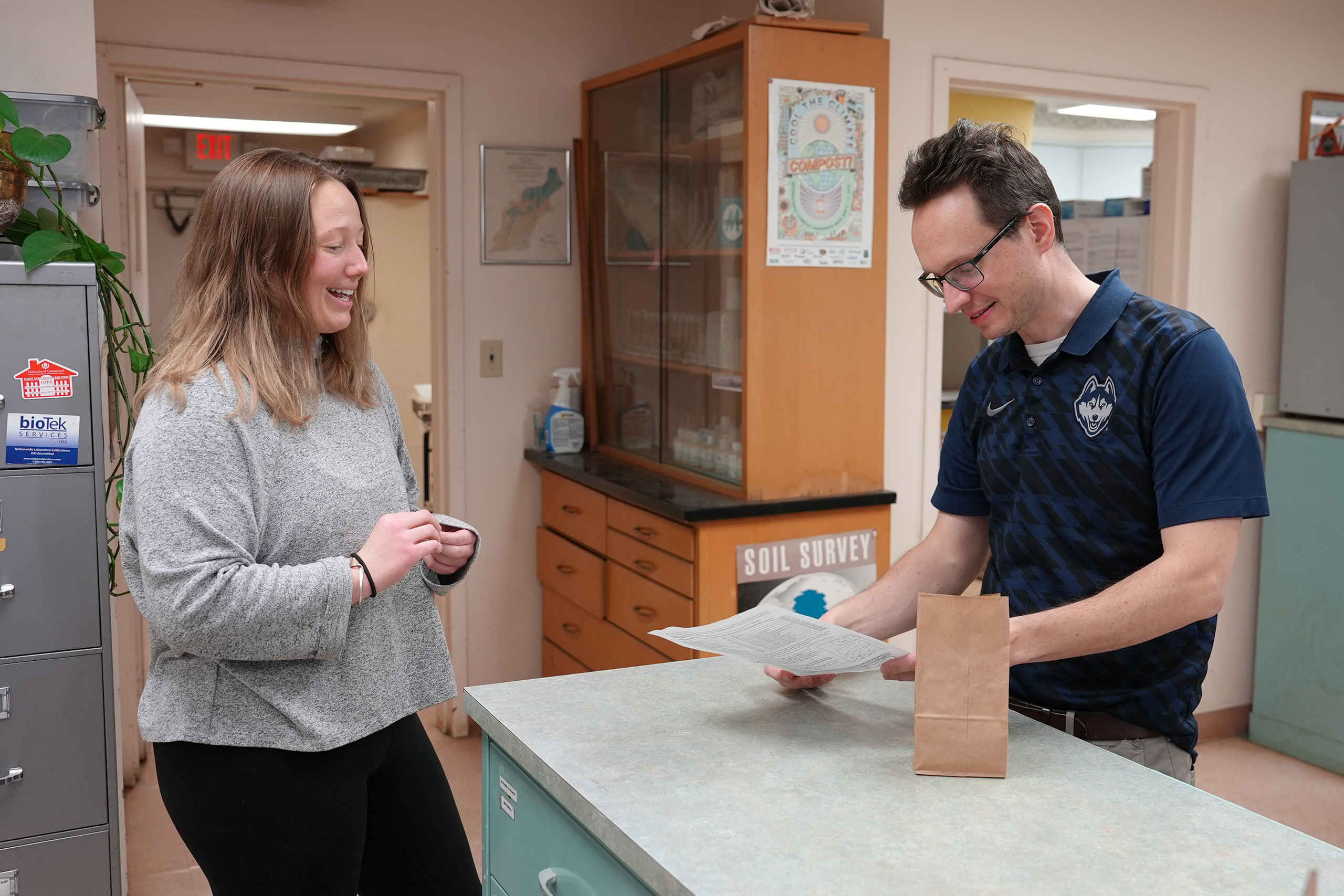
You do not need an appointment to drop off soil, plant, or turf samples. Each lab’s submission form lists mailing and drop-off options, and the Center will have shared sample drop-off points so you can leave materials during regular business hours. Appointments are mainly for in-depth consultations, tours, or special visits; if you need to meet with a specific specialist (for example, for a complex turf or disease issue), it is a good idea to contact that lab in advance to be sure the right person is available.
Choosing the right service
How do I know which lab to use: Soil Nutrient Analysis Lab, Plant Diagnostic Lab, Turf Diagnostic Lab, or Home & Garden Education Office?
- Use the Home Garden Education Office (HGEO) when you are not sure where to start or you have general “how do I…” questions about plants, gardens, or lawns. HGEO can often answer your question directly or help you decide which lab to use.
- Use the Soil Nutrient Analysis Lab (SNAL) when your main question is about soil fertility, pH, nutrients, organic matter, salts, or metals. Typical questions: “Do I need lime?” “Am I low in potassium?” “Is there lead in my soil?”
- Use the Plant Diagnostic Lab when you have a plant problem you suspect is caused by disease, insects, or other biotic/abiotic stress (wilting, spots, blights, dieback, sudden decline). Typical questions: “What is killing my tomato plants?” “Is this a disease or herbicide injury?”
- Use the Turf Diagnostic Lab when the main issue is turfgrass (golf courses, sports fields, lawns, institutional turf) and you need a diagnosis and management plan for patches, dead spots, or chronic decline.
I have a plant issue but I’m not sure if it’s a disease, a soil nutrition issue, or something else. Where should I start?
- If you are a homeowner or community gardener, a good first stop is the Home & Garden Education Office. If you’re unsure what’s affecting your plant, start by emailing clear photos and a brief description of the problem to our Home Garden Education Office at ladybug@uconn.edu. Our team will review your submission, help identify potential causes, and let you know if any diagnostic tests are recommended.
- If you are a commercial grower, you may want to do both at once:
- Send a plant sample to the Plant Diagnostic Lab for disease/insect/abiotic diagnosis, and
- Send a soil (or media) sample to the Soil Nutrient Analysis Lab for pH and nutrient status.
- Together, these results give a clearer picture of whether the issue is biological, nutritional, or both.
Can different units share information about my sample or question?
Yes, the Plant & Soil Health Center is designed so units can work together when it helps you get a better answer.
With your permission, staff may share relevant information (such as your soil test report, diagnostic findings, or a summary of your question) between the Soil Nutrient Analysis Lab, the Plant Diagnostic Lab, the Turf Diagnostic Lab, and the Home & Garden Education Office. This avoids making you repeat your story several times and allows specialists to coordinate soil, plant, and management recommendations.
We do not share your information outside UConn Extension and the Plant & Soil Health Center without your consent, except as required by law or UConn policy.
Logistics, payment, and turnaround
Where can I drop off samples for any of the labs?
All soil, plants, turf, and compost samples for any of the labs in the center can be shipped to or dropped off at the Plant & Soil Health Center in the Roy E. Jones Building (George Leigh Minor Plant & Soil Health Center, 27A Manter Road, Storrs, CT). There is a secure weather-protected outdoor drop box outside the building for after-hours deliveries of soil and compost samples. [Nick add special instructions for plant samples for diagnostic purpose]
What payment methods do you accept for lab services?
You can pay for your services by check or money order made out to the University of Connecticut, as described on the soil test or plant diagnostic submission forms and FAQs. You can also make payment via secure online credit/debit card payment (via a UConn payment portal) and in-person electronic payments at the PSHC front desk. We do not accept cash, and typically cannot split a single order across multiple payment types. Internal UConn accounts, purchase orders, or invoices can be used by departments or institutional clients.
How long does it typically take to get results from each lab/unit?
Home Garden Education Office (HGEO) typically responds within 1 business day to all phone calls and emails
For soil and compost tests at SNAL, routine samples are usually completed within about 7–10 business days after the lab receives them; during the busy spring season (especially April and May), turnaround may stretch to 2–3 weeks because of high volume. Seasonal nitrogen services like the Pre-Sidedress Soil Nitrate Test (PSNT) are prioritized and typically reported within one business day during the June–mid-August window, so growers can adjust nitrogen quickly.
The Plant Diagnostic Lab aims for timely diagnosis of plant disease, insect, and abiotic problems; in practice, most routine samples are processed within several business days, with more complex cases taking longer if cultures, serological assays, or nematode extractions are needed.
The UConn Turfgrass Disease Diagnostic Center typically provides rapid diagnosis (≤ 24 hours) of receiving samples.
How do I get my test reports?
Across the Plant & Soil Health Center units, email is the easiest way to receive detailed reports, including photos, recommendations, and links to relevant fact sheets. All the units routinely email test reports as PDFs when you provide a valid email address on your submission form. Reports can also be mailed as hard-copy printouts on request. We primarily respond by email, but may also follow up by phone when helpful.
Are there any seasonal rush periods when turnaround is longer?
Yes. For SNAL, sample volume spikes in early spring as homeowners and growers prepare for planting. The lab notes that routine soil test turnaround, normally 7–10 business days, may extend to 2–3 weeks in April and May.
The Plant Diagnostic Lab and Turfgrass Disease Diagnostic Center are busiest during the main growing season, especially late spring through early fall, when disease and insect issues are most active. Peaks often coincide with wet, warm periods that trigger disease outbreaks, or with high-stress conditions on turf. During these times they still aim for rapid diagnosis, but complex cases may take longer simply because of caseload.
The Home Garden Education Office also experiences a heavy influx of questions from roughly April through September, reflecting lawn, garden, and tree/shrub problems. Simple questions may still be handled quickly, but clients should expect somewhat longer response times during those peak months.